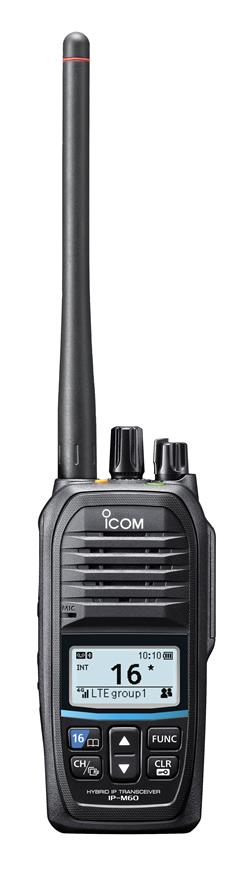
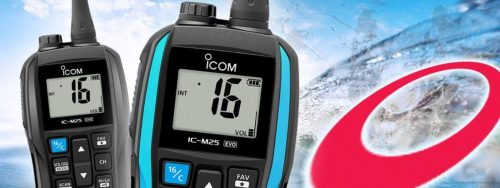
NRC Radio Recommends Icom Marine radios
Leading the way in the field of marine two way radios are Icom Marine, whose comprehensive selection of VHF and UHF radios are unsurpassed in their quality and reliability. Whether used for ship-to-ship or ship-to-shore communications, they are trusted to deliver crystal clear communications every single time, performing in adverse weather conditions and in beyond-line-of-sight environments.
Years of innovation, testing and dedication mean that Icom marine radios are the first choice of seafarers such as coastguards, rescue services and other marine professionals.
Why Icom Marine Two Way Radios are the Benchmark Against Which Others are Measured
Whether operating a small fishing vessel, a recreational yacht or a large merchant ship, the ability to communicate with other seafaring vessels, rescue services and shore-based stations is vital to the crew and passengers’ safety. Although radio technology has enjoyed a rapid evolution from the days of analogue communications, its function has not changed whatsoever, with clear, dependable communication still being the deliverable by which communications systems are measured.
Icom’s iconic range of marine two way radios offers digital, GPS-integrated communications systems with bidirectional voice communications and impressive signal clarity over extended ranges. With a VHF range of between 156 and 174 MHz, an Icom ship radio is capable of transmitting for up to 30 nautical miles in normal conditions and even further when the conditions are favourable. With such an impressive range, combined with a user-friendly interface, these radios are a common sight on many seagoing vessels.
Why a Ship Radio Needs Channel 16
The element that sets a marine radio apart from other two way radio communications devices is Channel 16, which operates at a frequency of 156.8 MHz. This is the international distress, safety and calling frequency, serving as the primary channel for “Mayday” alerts. All seagoing vessels are mandated to monitor this channel continuously while at sea, meaning that if a two way radio does not offer this function, it is unsuitable for use in this environment.
Many modern VHF radios also offer a feature known as Digital Selective Calling, or DSC, which is revolutionising distress signals, automatically transmitting a ship’s GPS position at the touch of a button to all DSC-equipped receivers within range, drastically improving response times and improving safety outcomes.
Radios that operate Channel 16 and Digital Selective Calling comply with the Global Maritime Distress and Safety System (GMDSS), which is a standardised system designed to unite ships, satellites and shore stations across a global network, ensuring that distress calls are always responded to.
A Guide to Choosing Marine Radios
VHF radios are designed for short to medium-range communication and are usually very well suited to use in the marine environment; however, some boat owners or captains may see the benefit in opting for an HF radio instead for its ability to transmit over greater distances, potentially over 1000 miles. Another benefit of HF radios is that they can receive weather forecasts, safety bulletins and navigation warnings that are transmitted over global maritime networks.
For vessels that primarily operate close to shore, such as those engaged in port and inland operations, UHF radios may be the most appropriate choice as they deliver high-clarity communication over a short range. They are particularly well suited to environments where signal reflection from physical structures or undulating terrain may adversely impact VHF and HF frequency bands.
Exploring the Man-Machine Interface
The Man-Machine Interface is a design premise that aims to minimise the risk of human error, particularly when operating in a high-risk environment. This is because at sea, time is of the essence, and the ability to immediately relay a distress signal can spell the difference between disaster and recovery. For this reason, marine radios must be intuitive with an ergonomic design and user-friendly interfaces. They should function absolutely logically and with no room for error or misunderstanding.
Icom is a manufacturer that is leading the charge in terms of the Man-Machine Interface. Their range of two way radios offers complex technologies such as GPS integration and Digital Selective Calling as standard, but displays them in such a way as to minimise confusion and doubt. The clear, visual indicators help operators to intuitively understand the function of every button and dial, while the backlit display ensures superior visibility both in bright daylight and at night. The large, tactile buttons are designed to be easily operated, even in PPE, while the hardened, waterproofed, corrosion and temperature-resistant casings are ideally suited to a salt water environment.
Why Buy Marine Two Way Radios From NRC Radio?
Our range of marine two way radios is chosen for its quality, meticulous engineering standards, rigorous testing and adherence to international safety and performance regulations. These devices have been stringently tested in the field to guarantee their reliability, and their impressive durability offers outstanding value for money and longevity.
Marine radios are the pinnacle of innovation, incorporating advanced features such as GPS, Automatic Identification, NMEA connectivity and even Bluetooth compatibility, allowing for hands-free use. Many include optional recording capabilities, which can be invaluable for reviewing transmissions or verifying instructions during high-stakes operations.
Marine communications are standardised and regulated by the International Telecommunication Union (ITU) and the International Maritime Organisation (IMO), meaning that all two way radios used in a marine environment must comply with global safety standards and that distress protocols and frequencies are standardised. This guarantees global interoperability and allows marine radios to communicate worldwide.
At NRC Radio, we have over 35 years of experience in the field of marine telecommunications and understand that this environment is dynamic and often unpredictable. We know that effective, clear communication is vital to your safety and that of your passengers and crew, and for that reason, we offer only the most effective, highly tested and trusted radios for your use.
Not only that, we expedite repairs and maintenance for our maritime users, ensuring your downtime is limited and carefully scheduled to satisfy your needs. We can perform on-site testing and demos, help you to select appropriate products and maintain and repair them for you. By delivering a complete service, we are contributing to a safer marine environment, now and in the future.
To find out more about our range of marine radios, accessories and aftersales support, please speak to a member of our team today.